
 Back to Investment overview
Profile
| Sector | Telecommunications |
| Gross Value Added (£bn) | £34.3 billion (2024) |
| Number of workforce jobs | 179,000 (2024) |
| Business investment | £9.2 billion (2024) |
| Key projects | Ofcom’s Three -Year Plan 2025-2028 |
| Key UKRN regulators | Ofcom |
| Regulatory approach | Ofcom is responsible for economic regulation (notably fixed telecoms network infrastructure), sector-specific rules on all providers, including sector-specific consumer protection (the general conditions), and enforcement. Ofcom also has concurrent powers with the CMA to enforce competition law and general consumer law. |
The UK telecoms market is characterised by a number of large, often overlapping, private service providers as well as smaller operators offering services to specific customer segments or in specific geographic areas.
- BT owns a nationwide fibre core network and last-mile network, allowing it to offer a range of fixed line voice, broadband and TV services to businesses and consumers, as well as a range of wholesale services to other telecoms providers. BT is deploying a new full fibre network across much of the UK. BT provides services across the UK except in Hull, where KCOM is the incumbent provider of telecoms services.
- Virgin Media O2 owns cable and fibre networks that cover approximately 60 percent of UK households, offering fixed line voice, broadband and TV services.
- In recent years, in part facilitated by a regulatory strategy to promote investment and competition in full fibre, many new network operators, collectively known as altnets, have entered the market in direct competition to both BT and Virgin Media O2. They have deployed new alternative network infrastructure for the wholesale and/or retail provision of broadband services.
- Sky, TalkTalk, Vodafone and a number of other ISPs (Internet Service Providers) offer retail fixed line, broadband or TV services, provided over BT’s network (where wholesale access is regulated) and alternative networks.
- There are also a number of operators that provide services targeted at larger businesses including, voice and data, connectivity, mobility, data hosting and warehousing, network security, cloud computing and others.
- In mobile telecommunications, following the merger of Vodafone and 3UK in 2025, there are now three large mobile network operators (“MNOs”), which own network infrastructure and provide retail services to consumers and businesses. Each of the three main network operators now offers a 5G mobile service. There is also a range of mobile virtual network operators (“MVNO”s), which purchase network access on a wholesale basis from MNOs.
- At the retail level there is considerable convergence of services being offered, with numerous companies providing a package of fixed and mobile voice, broadband, TV and data services to households and businesses.
The telecoms regulatory model is different from that of other infrastructure regulators, which stems primarily from the different duties that govern Ofcom’s approach to regulation of telecoms networks. Ofcom’s main duties are set out in the Communications Act 2003.
Ofcom’s primary duty is to further the interests of citizens in relation to communication matters, and to further the interests of consumers in relevant markets, where appropriate by promoting competition. Ofcom’s regulatory approach for fixed telecoms is to promote network competition where viable, and elsewhere promote competition based on access to BT’s network. Ofcom does not regulate retail prices in telecoms markets.
The telecommunications sector also differs from other sectors in that the requirement to apply for a licence was replaced by the general authorisations regime in 2003. This applies general conditions to all operators and specific conditions that apply based on the types of services offered or customers served.
Ofcom is the sectoral regulator for the communications sector – in addition to the regulation of fixed-line and mobile telecoms set out above, Ofcom is also responsible for regulating TV and radio broadcasting, video-on-demand and online services, post, and the radio spectrum used by wireless devices. More recently, Ofcom has taken on responsibility for regulating UK-established video sharing platforms, online services that host user-generated content (such as social media), messaging services and search engines.
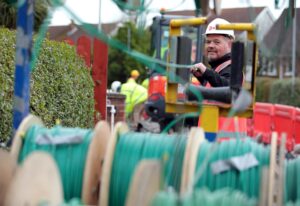
Ofcom offers a range of information that may be of interest to analysts and the investment community, including detailed research on our regulated markets.
Ofcom’s approach to managing relationships with the global investment community interested in UK communications sectors includes a running programme of engagement with investors (public and private), analysts, investment bankers, credit rating agencies and other interested market participants. Ofcom arranges meetings and calls both directly and via stockbrokers and analysts. Periodically, Ofcom also hosts briefings or conference calls, which are open to the investment community.
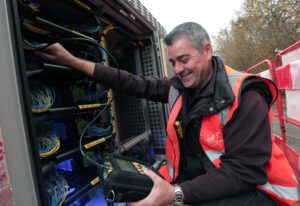

Ofcom’s Analyst and Investors Relations team liaise with the investment community and respond to queries on regulatory policy issues and research findings. They are happy to answer queries over the phone or arrange bilateral meetings to discuss areas of interest in detail. Ofcom immensely values the feedback from such engagement, recognising that investors need clarity around regulation, and the confidence to invest that comes with it.